Transforming Contract Review with BlackBoiler's AI
Table of Contents
- What BlackBoiler Brings to Contract Review
- The Technology Behind Automated Redlining
- Industry Specialization in Construction and Banking
- How First-Pass Contract Review Works
- Automated Markup Versus Suggestion-Only Competitors
- Target Markets and Implementation Considerations
- Real-World Applications and Workflow Integration
- Return on Investment and Time Savings Metrics
- Common Implementation Challenges and Solutions
- Bottom Line
- What BlackBoiler Brings to Contract Review
- The Technology Behind Automated Redlining
- Industry Specialization in Construction and Banking
- How First-Pass Contract Review Works
- Automated Markup Versus Suggestion-Only Competitors
- Target Markets and Implementation Considerations
- Real-World Applications and Workflow Integration
- Return on Investment and Time Savings Metrics
- Common Implementation Challenges and Solutions
- Bottom Line
What BlackBoiler Brings to Contract Review
TL;DR: BlackBoiler, NSF-funded and powered by patented NLP technology, revolutionizes automated contract markup, aiding industries like construction and banking with AI redlining capabilities.
Contract review has traditionally demanded significant attorney hours, especially for high-volume practices dealing with construction, banking, and procurement documents. Enter BlackBoiler, funded by NSF and utilizing patented NLP technology, designed for automated contract markup. Legal teams, particularly in construction and finance, find BlackBoiler a game-changer. It integrates AI redlining into automation, transitioning from AI-assisted review to genuine automated markup without constant oversight.
The Technology Behind Automated Redlining
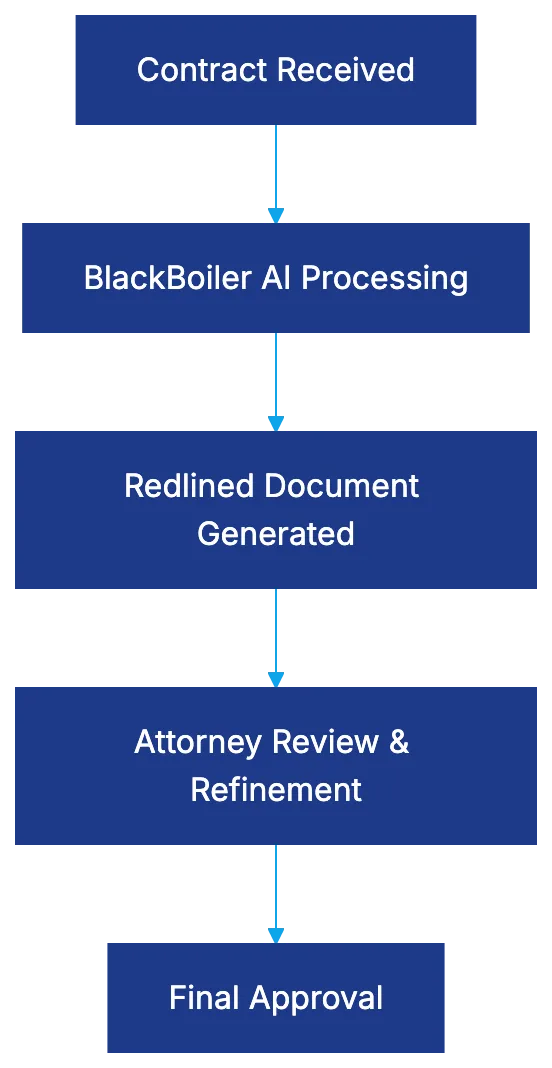
Traditional vs. BlackBoiler Contract Review Process:
At BlackBoiler’s core lies patented NLP and machine learning, developed with NSF support. It surpasses typical document analysis, reviewing contracts against your firm’s playbook, and provides marked-up documents with precise edits. BlackBoiler executes edits where standard AI tools identify issues.
This NLP engine comprehends context beyond simple keywords. For instance, it discerns language variations in indemnification clauses that encapsulate similar legal concepts, achieving the same legal outcomes or materially different obligations. This advanced understanding enforces your playbook standards, even when contract language diverges from your templates.
Additionally, machine learning enhances over time, functioning effectively right from setup while refining its grasp with document handling.
Industry Specialization in Construction and Banking
BlackBoiler specializes in industries like construction and banking, where contract volumes pose challenges. These sectors generate agreements necessitating consistent risk policy application across transactions, affecting deal flow and costs.
NLP Technology Processing Flow:

For construction firms, BlackBoiler handles subcontractor agreements, procurement, and vendor arrangements. It accommodates prevalent issues reflecting industry practices and your risk profile.
In banking, it processes loan documents, credit agreements, and contracts involving collateral, default provisions, and regulatory compliance, applying standards consistently across loan officers and branches.
How First-Pass Contract Review Works
First-pass review with BlackBoiler contrasts traditional processes. Attorneys or paralegals used to compare contracts manually against playbook standards. BlackBoiler applies your standards, generating a redlined document for attorney review, shifting focus from drafting to refining AI-generated edits.
This alters workflow significantly. Starting with AI-generated markup shifts focus to evaluation rather than creation, enhancing consistency by applying playbook scrutiny across each contract for human review.
Automated Markup Versus Suggestion-Only Competitors
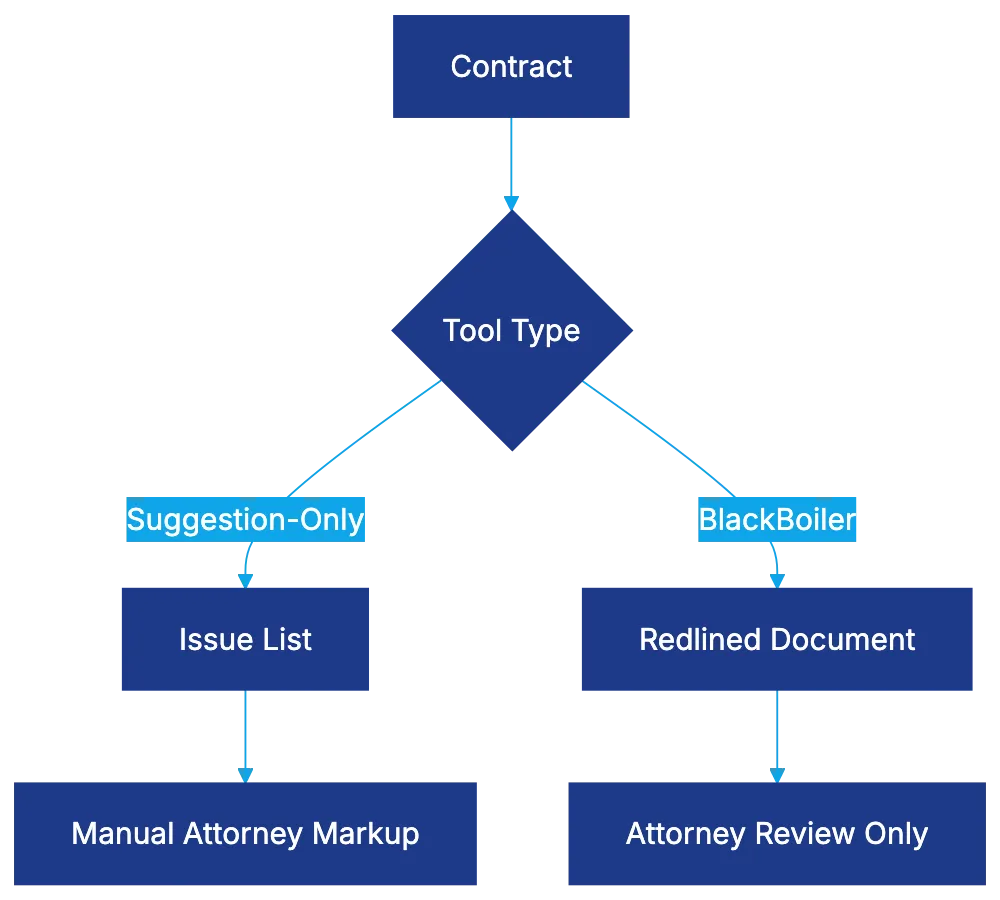
Understanding BlackBoiler necessitates knowing contract AI landscape differences. Many AI tools suggest changes, but BlackBoiler marks up the document, providing a redlined contract ready for review, not just an issue list needing manual markup. Suggestion-only tools spot issues but still require manual attorney markup, whereas BlackBoiler offers the first draft for review.
Automated Markup vs. Suggestion-Only Tools:
Target Markets and Implementation Considerations
BlackBoiler targets construction companies managing agreements and financial institutions handling loan documents. They find automated markup advantageous for consistency and playbook positions.
Setup involves training the system on playbooks and risk positions, configuring pre-developed capabilities rather than crafting custom models.
Real-World Applications and Workflow Integration
Consider a construction company receiving subcontractor agreements. Traditionally, each is reviewed against standards. With BlackBoiler, all agreements are processed through the platform, generating marked-up versions for review.
A bank handling loan agreements ensures consistency through BlackBoiler, enhancing documentation speed.
Automated markup is valuable where contract volume exceeds review capacity, performing routine tasks and allowing human expertise to focus where needed.
Return on Investment and Time Savings Metrics
Quantifying ROI involves analyzing cost and time savings. Direct savings arise from reduced time on first-pass review, with faster contract turnaround impacting operations beyond legal departments.
Additionally, improved consistency mitigates potential expensive problems later. Setup costs, including subscriptions and training, weigh against hiring more reviewers or counsel reliance.
Common Implementation Challenges and Solutions
Challenges include playbook clarity and consistency, gaining attorney trust and adoption, demonstrating accuracy, and maintaining human review. Technical integration with existing systems requires attention, facilitated by BlackBoiler’s API capabilities.
Bottom Line
BlackBoiler represents an evolution in legal AI technology, shifting from issue identification to solution drafting. Its NLP approach addresses pain points for legal departments managing high document volumes. For organizations with established playbook positions, time savings on first-pass reviews improve consistency. It works best in attorney-supervised workflows, retaining human involvement for complex negotiations. Understanding its fit in your practice is crucial in evaluating its value.
Frequently Asked Questions
How can BlackBoiler improve the contract review process for my legal team?
BlackBoiler automates the contract markup process, significantly reducing the time attorneys spend on first-pass reviews. By generating redlined documents that align with your firm's playbook, it allows legal teams to focus on refining edits rather than creating them from scratch.
What types of contracts can BlackBoiler handle?
BlackBoiler specializes in high-volume contract types, primarily in construction and banking sectors. This includes subcontractor agreements, procurement contracts, loan documents, and credit agreements, ensuring consistent compliance with your organization's risk policies.
What are the initial steps to implement BlackBoiler?
Implementation involves training BlackBoiler on your organization's playbooks and risk positions. This process utilizes pre-developed capabilities, streamlining setup without the need for extensive custom models. Ongoing adjustments can be made as you evaluate its performance.
What challenges might we face when adopting BlackBoiler?
Common challenges include ensuring clarity and consistency in playbooks, gaining attorney buy-in, and integrating with existing systems. Addressing these issues early, alongside demonstrating the tool's accuracy and reliability, can facilitate smoother adoption.
Does BlackBoiler require constant human oversight after setup?
While BlackBoiler significantly automates the review process, it is still recommended to have human oversight, especially for complex negotiations. The system enhances efficiency but retains the value of human judgment for nuanced legal discussions.
What is the expected return on investment (ROI) when using BlackBoiler?
ROI can be gauged through time and cost savings resulting from reduced first-pass review times. Additionally, increased consistency in contract processing may mitigate risks and expensive errors that could arise later in the negotiation process.
How does BlackBoiler differentiate itself from suggestion-only AI tools?
Unlike suggestion-only tools that merely identify issues, BlackBoiler automates the markup process, providing a fully redlined contract for review. This capability allows legal teams to skip manual markup and focus directly on evaluating the generated edits.
Related Articles
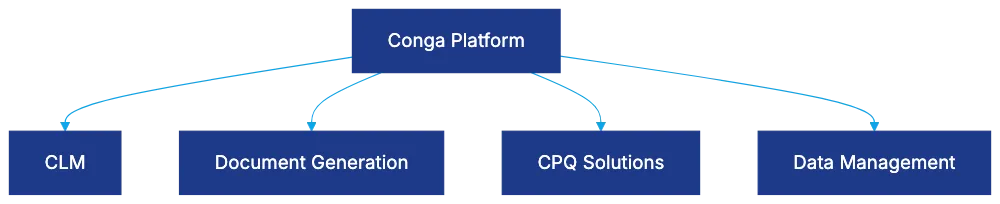
Conga: Revolutionizing Legal Technology for Professionals
Discover how Conga streamlines contract management and document generation for legal teams using Salesforce.
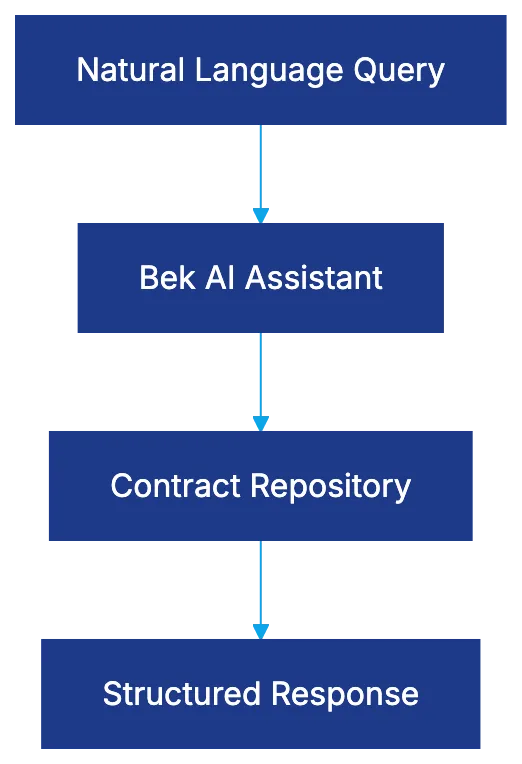
Malbek's Innovative Take on Contract Lifecycle Management
Explore how Malbek's conversational AI transforms contract lifecycle management for legal teams in mid-market and enterprise organizations.
Summize: Revolutionizing Contract Management in Teams
Discover how Summize enhances contract management through Microsoft Teams with AI-driven solutions and seamless integration.